






Projet "Chronika" : Dans le cadre de stages de formation, le projet Chronika a été enrichi de neuf nouveaux numéros de BCH. Les notices des BCH 97 à 105 sont en ligne depuis avril 2026.
Pour en savoir plus, consulter la page du projet.
*Projet "Cadastre Archéologique" - prochainement...
Outil indispensable pour les chercheurs de toutes disciplines qui souhaitent s'informer des dernières découvertes archéologiques en Grèce et à Chypre, la Chronique des fouilles en ligne/Archaeology in Greece Online est une base de données richement illustrée, disposant d'un outil cartographique pour localiser les opérations de terrain.
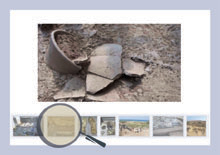


Islands in the Saronic Gulf. Christopher Nuttall (Swedish Institute at Athens) reports on the second year of the Little Islandscape of the Saronic Project (LISP). In Panagitsa (Lagousaki) island, the survey traced material dating to the Classical and Hellenistic periods, as well as the Byzantine and modern. This was mostly pottery and a limited number of architectural elements. The largest concentration of pottery was found in the NE part of the island. Finds include black-glazed...
Aigina - Hellanion Oros. Stella Chrysoulaki (Ephorate of Antiquities of Piraeus and islands) and Tobias Krapf (ESAG), Leonidas Bokotopoulos – Sophia Michalopoulou – Jérôme André (University of Lausanne), report on the fifth season of a five-year project on Hellanion Oros in Aigina, a synergasia between the Ephorate of Antiquities of Piraeus and islands and ESAG. The research took place at the area north of the chapel of the Ascension, where buildings belong to the...
Ewdoksia Papuci-Wladyka (PAIA) reports on the first excavation season of a three-year project (2024-2026) conducted by a Polish-German-Greek research team, under the auspices of the Polish Archaeological Institute at Athens in Thelpousa, Arcadia, Greece. Thelpousa was an Arcadian polis located approxi- mately 25 km east of ancient Olympia in the lower Ladon valley north of the modern village of Toumbitsi (Fig. 1). The origins of Thelpousa, situated on the left bank of the river, date...
Karfi - Lasithi, Crete. Krzysztof Nowicki and Saro Wallace from the Polish Academy of Sciences in Warsaw report on the continuation of excavations at Karfi in Lasithi, under the auspices of the Polist Archaeological Institute at Athens. The 2024 excavation at Karfi, Lasithi, Crete, focused on three areas (A, B and MG1), investigating the Late Minoan IIIC settlement (c. 1200–1050 BC), earlier Middle Minoan activity (c. 1800–1700 BC), and evidence of later reuse. (Fig. 1) In Area A,...
Acharnes – Crete. Efi Sapouna-Sakellaraki (Archaeological Society of Athens and Ephorate of Antiquities of Euboea) reports on the continuation of the archaeological research in the Minoan Palace of Acharnes. The principal focus of the 2025 campaign was a double, oblique wall that enclosed a substantial part of the palace courtyard. (Fig. 1) Its apparently crude construction, using unworked stones, had initially raised questions about its function and relationship to the carefully...
À Égine, le programme de fouilles sous-marines du port militaire (« Aigina Harbour City Project ») s’est poursuivi en 2025 pour la sixième année, sous la co-direction de Kalliopi Baika et Jean-Christophe Sourisseau (Université Aix-Marseille/CCJ-CNRS) et de Paraskevi Kalamara (Musée Byzantin), ainsi que de Despoina Koutsoumba (Éphorie des antiquités sous-marines) et en partenariat avec plusieurs universités et instituts de recherches. La recherche s’est concentrée en...
À Délos, Cécile Durvye (AMU/EFA) a poursuivi, en 2025, l’étude architecturale du sanctuaire d’Aphrodite. La mission a porté sur le temple et l’autel et a notamment permis de compléter le relevé des blocs errants nécessaire aux restitutions, de finaliser la restitution de la charpente et de la toiture, et de l’intégrer à la réalisation d’un modèle 3D du temple, de compléter les études de détail et les illustrations pour la préparation de la...
À l’Héraion de Délos, Gilberto Da Silva (Université de Sao Paulo/EFA) a dirigé en 2025 une nouvelle mission d’étude architecturale, consacrée à l’enregistrement des vestiges architecturaux : le catalogage des blocs correspondant au temple B et l’enregistrement de la base de statue de...
À Doriskos (fig. 1), Anca Dan (CNRS-ENS Paris), Chryssa Karadima (Éphorie des antiquités du Rhodope) et Domna Terzopoulou (Éphorie des antiquités de l’Hèbre, Alexandroupoli) ont co-dirigé en 2025 une nouvelle mission de terrain. Les prospections géophysiques ont été effectuées par Ercan Erkul et Wolfgang Rabbel (Université de Kiel, Excellece Cluster Roots) avec la participation de leurs étudiants Jan-Daniel Beese, Simon Fischer, Johannes Gehrig, Karoline Spiess et Anna Ziel. Les...
Antikythera. A. Simosi (Emerita Director, Ministry of Culture) and L. Bäumer (ESAG / University of Geneva) report on the final year marked the fifth and final phase of the underwater excavation at the Antikythera Wreck (2021-2025). Wooden remains of the ship's hull discovered in 2024 were carefully recovered. These include three plank sections from the ship's planking and a fitted inlaid element (a strut) (Fig. 1). This find is considered extremely important, as it is the first...
Rescue excavations in Athens have produced exciting and significant finds during 2024–25. On Vasilissis Olgas Avenue, a large Roman-era complex was uncovered near the statue of Lord Byron, a part of the city expanded eastward under the emperor Hadrian (Fig. 1). The site includes more than 60 rooms organized around a peristyle courtyard, in a building approximately 68 m long and 11 m wide. Excavations revealed three construction phases: an initial 2nd-century AD phase built with...
Dans la ville antique de Miéza, Aggeliki Kottaridi (Éphorie des antiquités d’Émathie) a dirigé un programme de recherches sur le gymnase royal, au cours duquel elle a mené des fouilles, des nettoyages et documentation des objets, et l’étude comparative avec les objets des campagnes précédentes de fouilles, ainsi que des travaux préparatoires à l’étude de conservation et de restitution du complexe monumental et de l’anastylose de la partie occidentale du xyste, du portique...